Saturday, November 3, 2018

(From The Archives) Shut Up & Read The Truth About Cartier Watches

…is what I often like to say to my fellow watch friends when they start again asking the same silly questions about Cartier.

It was 1983 or 1984 when I bought my first real watch; the Cartier Santos. That was, of course, the square watch in steel with yellow gold lunette and steel bracelet with yellow gold screws. It was hot like hell and became the most copied watch. It was also that watch that made me interested in the history of the brand since the dealer told me that the design was inspired from the first men’s wristwatch, launched by Cartier in 1904. So you can imagine that it did not take long before I became obsessed with watches in general, especially with Cartier.

Collection Privée, Cartier Paris

Cartier Tank

At that time watch forums were just becoming popular, watch magazines were still rare and watch blogs like Fratello and Hodinkee did not exist yet. But what we had around in 1995, were the ‘Get Togethers’ with other watch enthusiasts (fanatics). These GTGs were organised by collectors themselves and were always quite amusing. Everyone brought a few pieces from their collection and with loads of beer and wine, we chatted about the various models until late in the evening. But always the same brands got all the attention and for me it was quite frustrating that one only paid attention to my Cartier watches, to be polite. The word ETA was always mentioned as if these were inferior movements and too often I heard quotes like; ‘my wife would love them!’

High-end Mechanical

Cartier was aware of the fact that men, interested in, let’s call them, ‘the better watches’, were more educated about timepieces, than the average Cartier client was and that these men were also more interested in the quality of the movements. That resulted in 1998 in the launch of the, at the male consumer targeted, ‘Collection Privée, Cartier Paris’ series. A collection of limited edition and limited produced watches, housed in Cartier’s classic cases like the Santos, Tank, Tortue, but more important, powered with high-end mechanical calibers made by famous watch brands, for Cartier.

Cartier CPCP

In-house Movements

Piaget, JLC, Frederique Piguet, Gerald Genta and others all delivered these quality calibers for this top of the line series. The excellent finishing of the movements, was done by Cartier and was visible through the back, since many of the models had a glass back, to see the movement. A feature that was pretty unusual at that time. Collection Privée was, however, too limited in quantities to be a real success, since many of the models were only produced in 100 pieces, while Cartier had already over 200 brand Boutiques at that time. One would expect that my WIS (Watch Idiot Savant) friends at the GTG meetings would be excited about the pieces I showed, but that was only partly the case since another trend had become popular among these guys; ‘in-house movements’. A grail watch needed to have an in-house movement to be the real thing (deal).

Manufacturing Decisions

During the Collection Privée period, 1998 – 2008, Cartier often faced problems in getting all the parts from their suppliers and it often happened that a watch was released later than planned, due to the fact that some parts were not available in time, to finish the watch.

So besides the fact that an in-house movement was becoming more and more important, Cartier realised very well that to be really successful and reliable in the world of high-end watches, they had to produce not only their own calibers, but also as many parts as possible, like the case, springs, rotors, dials, hands, glass etc.

A New Manufacture In La Chaux-de-Fonds

Cartier built, during the Collection Privée period, a huge – over 30.000 square meters – manufacture in La Chaux-de-Fonds (see our coverage here) and started to work with a selected group of watchmakers on a follow up project to be launched in 2008, all led by Carole Forestier-Kasapi, the genius watchmaker that was hired in 2005 and had worked at Audemars Piguet (Renaud & Papi) and Van Cleef & Arpels. This very modern and high-end manufacture is now together with the Rolex and Omega manufacture, the largest in Switzerland!

Cartier Manufacture

ID-ONE and ID-TWO

The very first result of Cartier’s high-end watchmaking was presented in November 2007. A – by Carole Forestier-Kasapi –  developed Flying Tourbillon caliber was shown to the press. Unfortunately, the watch was housed in a 47mm over-sized Ballon Bleu case, following the large watch trend.

Since the release of that Flying Tourbillon, Cartier didn’t rest on their laurels. While other top brands like Audemars Piguet were taking it quietly and pleasing the watch fanatics with ‘Offshore’ after ‘Offshore’, year after year, Cartier made over-hours and invented new materials, new calibers and surprised the press every January at the SIHH with real novelties. In 2009, and again in 2012, Cartier even invited over a hundred journalists from around the globe and flew them into La Chaux-de-Fonds, to present the ID-ONE and ID-TWO watch at their manufacture. Two prototype watches that would never hit the market, but were created for research and – of course – to show the press how far ahead Cartier was in fine watchmaking.

Cartier ID-TWO

Inventive

In a nutshell; the ID-ONE is the first watch that would never need any kind of service of what’s so ever!  The ID-TWO is the logical successor of the ID-ONE and it takes us a few steps further, in Cartier’s new way of ‘high tech’ watchmaking. This timepiece is capable to store energy much more efficiently than conventional watches, it uses less energy and it distributes the energy in a much more effective way. It needed to prove that the reliability, efficiency and accuracy of a mechanical or automatic caliber could be improved. The ID-ONE and ID-TWO were created to bring the Cartier’s watch collection to an even higher level in the very near future and in fact, Cartier’s collection is now already benefitting from these inventions.

Scandalous

Since it is actually a bit scandalous to find out that even the well-known watch collectors don’t always have a clue what Cartier has achieved during the last 8 years, I wrote this brief summary to give an idea how Cartier has developed to a high-end watch brand. And to illustrate my words, I will go through the collection, to highlight just a few ‘must-know’ timepieces, in order to get all the quartz- and ETA nonsense, where I am constantly confronted with, out of the way and to let you think differently about the brand that has been dominating the watch industry for years with amazing designs but will keep on dominating the industry with their on-going inventions.

Cartier Highlights

Ballon Bleu Flying Tourbillon

Cartier presented their first high-end Flying Tourbillon movement (caliber 9452MC) in 2007. This was the caliber that received the first Geneva Seal for Cartier. Unfortunately, the movement was presented in a too large 47mm Ballon Bleu case. But in the meantime, much more wearable 40mm Rotonde and gorgeous Ballon Bleu Flying Tourbillon models have been launched.

Cartier's 9452MC movement

Calibre de Cartier

A very important development was the automatic 1904MC caliber that was presented in 2011. A thin automatic caliber with 48 hours of power reserve, featuring the time with a subsidiary seconds dial @ 6 and a date complication. Cartier made sure that it had enough differences in comparison to most of the base movements offered by ETA. The ‘Calibre de Cartier’ was the first watch that was powered with the 1904MC, but soon after Cartier started the use the caliber as the base for various Chronographs and Perpetual Calendar calibers.

Cartier 1904MC Caliber

Cartier Diver

The new Calibre Diver, that was launched last year, is also powered with the 1904MC. It is the first diver watch for Cartier and is, believe it or not, the slimmest Diver in the world. The case diameter is 42mm and the watch has a height of just 11mm. For a diver watch that’s really flat, when compared to – for instance – the famous Rolex Submariner that has a height of 12,5mm or the Rolex Sea-Dweller DeepSea that measures 17,68mm. As it should be, the back of the case is closed and the bezel is self-lubricating and unidirectional, steel coated with ADLC, a material that is harder than steel. The sapphire crystal that is 1.2mm thicker than that of the regular ‘Calibre de Cartier’ model, makes sure that it can withstand the water resistance of 300m, which is the same as the Submariner and better than the 100m water resistance of Panerai models in the same price category.

Cartier Calibre Diver ADLC

Lubrication Free Tourbillon

A watch that directly took benefit from the technology of the ID-ONE is the Astro Tourbillon Carbon Crystal that was presented in 2013, in a limited edition of 50 pieces. This new ‘Astro Tourbillon Carbon Crystal’ was released in a Niobium-titanium case, a lightweight and non-magnetic alloy, that resists corrosion, scratches and shocks and it has the carbon escapement of the ID-ONE. This watch is the Worlds first escapement adjustment-free and lubrication free tourbillon. If service on the movement can now be reduced to (almost) none, the sky will be the limit for the future generation of Cartier’s tourbillon models.

Cartier Astro Tourbillon Carbon Crystal

Rotonde Annual Calendar

The handsome looking Rotonde Annual calendar with grande date and automatic in-house caliber 9908 MC, is an example of a complicated movement that’s based on the 1904 Caliber. All corrections of the watch can be made via the crown and only needs one correct per year.

Cartier Rotonde Annual Calendar

Skeleton ADLC

This Santos Dumont Skeleton (below) was after the Santos 100 skeleton, the second model that featured the new 9612 MC mechanical skeleton caliber. A very eye-catching watch that comes with a white-, pink gold or ADLC coated titanium case. The skeletonized bridges are in the shape of Roman numerals and are, in case of the all-black version, ADLC coated. It has very wearable dimensions of 38.7 x 47.4mm.

Cartier Santos Dumont

Rotonde de Cartier Mysterieuse

The Rotonde de Cartier Mysterieuse (below), in 42mm, is a prime lead where history meets technology. Cartier was the first brand in presenting a mystery clock in 1912. It was developed by Maurice Coüet for Cartier. Hundred years later Cartier built especially a new in-house caliber for their Mysterieuse watch, a caliber that was built around sapphire crystal dial with the floating hands. Cartier’s watchmakers had to overcome difficulties like driving of the sapphire discs with the minute hand and the one with the hour hand plus the friction between them. Instead of adopting the system that was developed by Maurice Coüet for the vintage Mystery clocks, Cartier did it on its own way and decided that they should turn on light pivots, actually like wheels in a gear train.

Cartier Rotonde Mysterieuse

Back side of the Cartier Rotonde Mysterieuse

Rotonde de Cartier Mysterious Double Tourbillon

To take the invention a step further La Maison also developed the platinum Rotonde de Cartier Mysterious Double Tourbillon. A timepiece that is aesthetically so impressive, that the large case of 45mm doesn’t really matter anymore. The flying tourbillon turning once on its own axis, every minute, is eye-candy. Completely moving free, in a see-through round chamber, without any visible connection to a gear train.

Cartier Rotonde Mysterieuse Tourbillon

Rotonde Grande Complication

An amazing piece in 2010 was the Rotonde Grande Complication. This year, however, Cartier prepared a huge presentation for the press, to introduce the 2015 version of the Rotonde Grande Complication (below), by no means another dial colour, or different case, but a completely different watch with Perpetual Calendar, Minute Repeater and Flying Tourbillon. Powered by the new skeletonized automatic caliber 9406MC, with a double platinum micro-rotor. The Grande Complication was rewarded with the Geneva Seal.

Cartier Grande Complication

Now You Know

Since 2007, Cartier’s team of watchmakers built (created) an impressive collection of about 40 different calibers, from the basic 1904MC to the very high-end complicated 9406MC. All watches in the top line have in-house calibers and within a few years, the whole mainstream collection will do too.

Thank you for reading and don’t forget that the brand ‘your wife loves so much’, has changed into this genius watchmaker you should pay attention to when you’re interested in high-end watchmaking!

This article was written by long-time Cartier expert George Cramer for Fratello Watches. George is a contributor to Revo-Online, Revolution Magazine and runs his own website as well where he keeps track of his various contributions about Cartier and his other (main) interest, independent watchmaking. This article was published for the first time on April 29th, 2015.


from Best Watches For Men https://ift.tt/2yTi3QJ

Weekend Round-Up: Wines That Pair With Turkey, Art That Inspires Films, And The Ubiquity Of CBD

Why Is CBD Everywhere? – The New York Times

Recently, CBD seems to be popping up everywhere you look – in lattes, juices, skincare, vape pens, and more. It’s said to treat a host of things, from anxiety to inflammation to cancer, and even non-weed smokers are being swayed. Here, Alex Williams outlines the sudden rise of CBD and investigates whether it is really a “magical elixir” or just the latest fad.

– Ashley Kinder, HODINKEE Shop Manager


from Best Watches For Men https://ift.tt/2RBdtO5

Friday, November 2, 2018

Omega Raises Its Warranty On All(!) Watches To 5 Years

Years ago, when Omega introduced their Co-Axial technology and silicon balance springs, they raised the warranty to 4 years (instead of the standard 2 years, which is also mandatory by European law for example). Now, Omega takes it one step further and decided to raise the warranty on all of their watches to 5 years, regardless of which watch model (or type of movement that is inside).

Warranty

Effective July 1st 2018

The new 5-year warranty will take effect from today, November 2nd, 2018 and will also be applied to any OMEGA watch purchased on or after July 1st, 2018. So yes, this also means your (and ours) Speedy Tuesday Ultraman will have the 5-year warranty. Yeeee.

Raynald Aeschlimann, President and CEO of Omega, said, “Our enduring commitment at Omega is to the satisfaction and confidence of our customers. All of our recent advancements, from pioneering technology to the state-of-the-art factory we opened one year ago, have enabled us to introduce this new 5-year warranty, proving that our standards are continually increasing and that our customers can have even more trust in the Omega watch they wear.”

It comes a bit as a surprise to us on the one hand because with the Master Chronometer certified watches the warranty was already valid for 4 years. An extra year is a nice plus for sure. What surprised us is that they also applied this new rule for all other watches as well, those with hand-wound chronograph movements (Lémania based), quartz movements and non-Master Chronometer certified automatic movements. In the future, Omega aims at full coverage with their Master Chronometer certification for all of their collection. With the new manufacture that opened exactly a year ago in Bienne, it seems that Omega feels confident enough to apply the 5-year warranty period to all watches.

Warranty

Omega’s new manufacture in Bienne

Other brands that offer a longer warranty period are Breitling for example, with 5 years on the watches with manufacture movements (those without having a warranty of 2 years), Rolex also with 5-years and Grand Seiko with a 3-years warranty. Brands like Patek Philippe, IWC, Panerai and Jaeger-LeCoultre offer 2-years (as written above, this is also often required by some laws).

Hopefully, it will never be necessary, but always make sure you are aware of the warranty period of a watch when you make the purchase. Luxury watches remain to be a product where there is a lot of manual interference and work done, so mistakes can be made (and will be made). Although most flaws and malfunction are likely to come to the surface well before 5 years of ownership, at least you are covered for a longer period as of now with your Omega watch.

More information via www.omegawatches.com/5YearWarranty


from Best Watches For Men https://ift.tt/2qodKbk

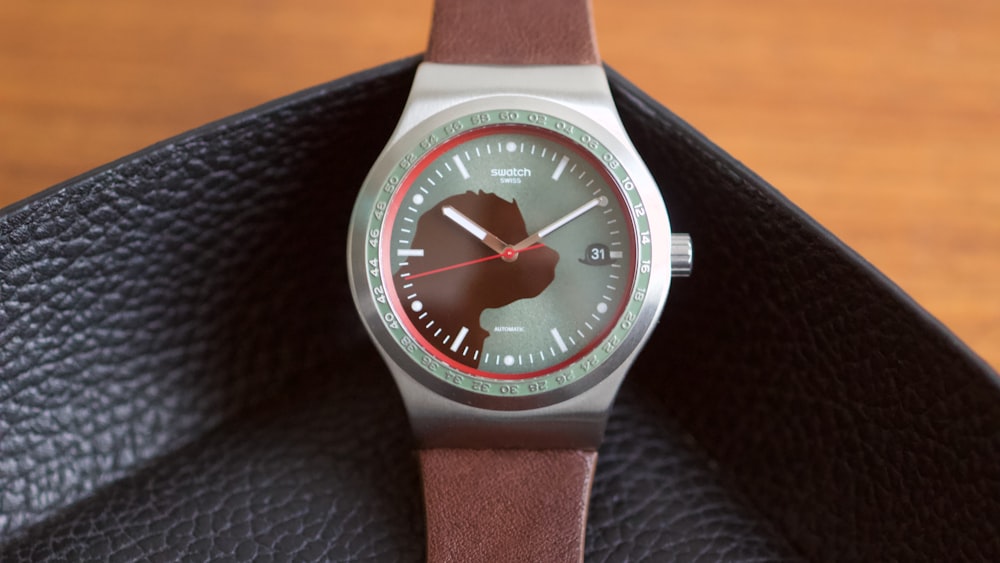
Introducing: The Swatch x Hackett Sistem51 Irony Limited Edition (Live Pics & Pricing)

The Sistem51 is badass. Plain and simple. Many of you will remember the Sistem51 HODINKEE Vintage 84 we launched almost one year ago – so there’s no doubt we really believe in the product line. However, this is a very different sort of take on the archetype. The Swatch x Hackett Sistem51 boasts a 42mm stainless steel case, a dark green dial with a brown silhouette of Mr. Jeremy Hackett’s beloved Sussex spaniel, Muffin (a fine looking specimen indeed). The date window is at three o’clock, framed in a bowler hat, a symbol of the Hackett brand, and the slim, fixed green bezel is broken down into two-second increments. 

Turn the watch over and you see the traditional Sistem51 architecture, including the entirely-made-by-machine movement. For this watch though, there’s a special “born in 1983” green stamp on the transparent case back. This is a watch that will undoubtedly be worn by both men and women comfortable in their skin and out to have fun – the best place to be. 


from Best Watches For Men https://ift.tt/2CYmAEr

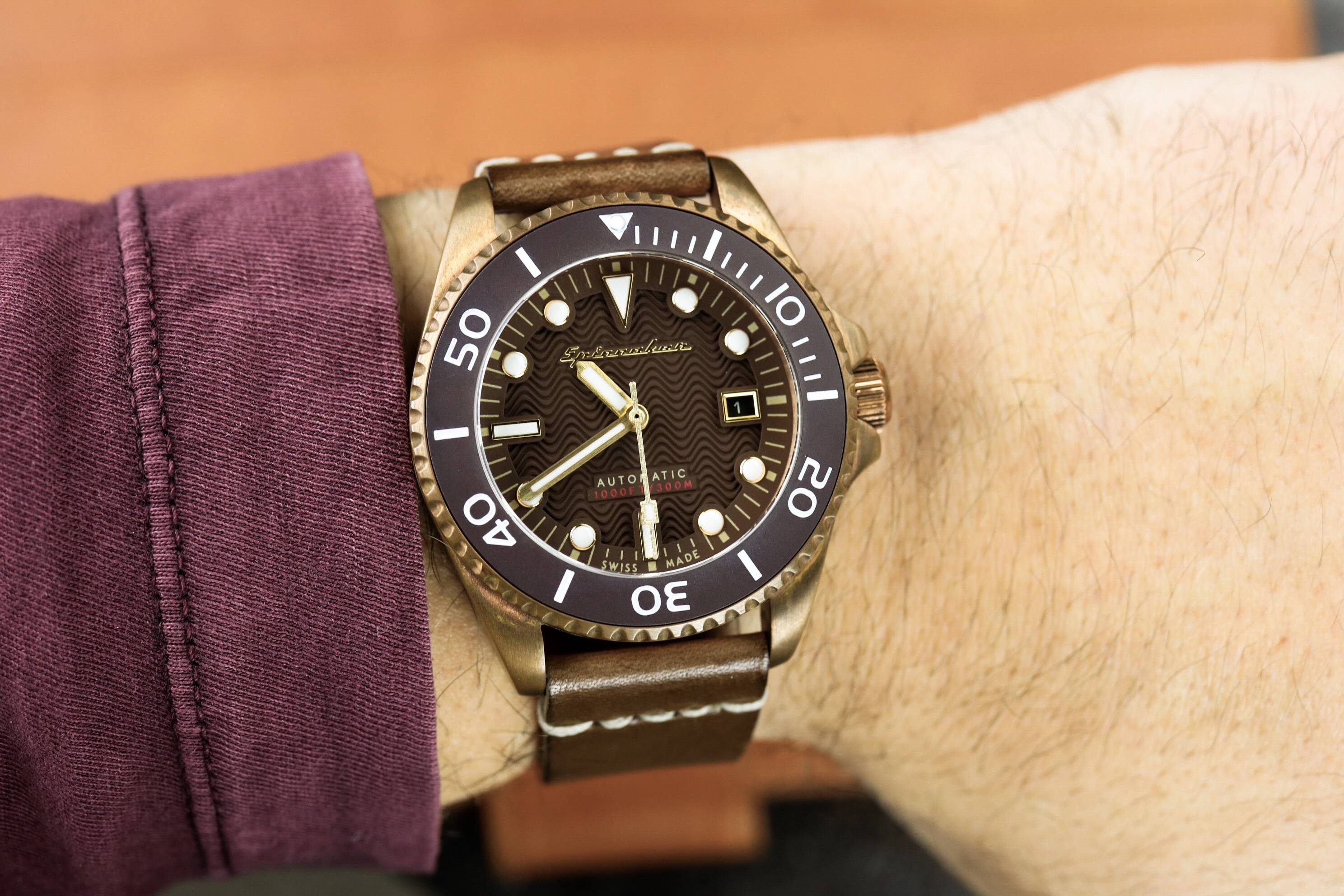
Spinnaker Tesei Bronze-Hands-On Watch Review

Spinnaker Tesei

Spinnaker Tesei

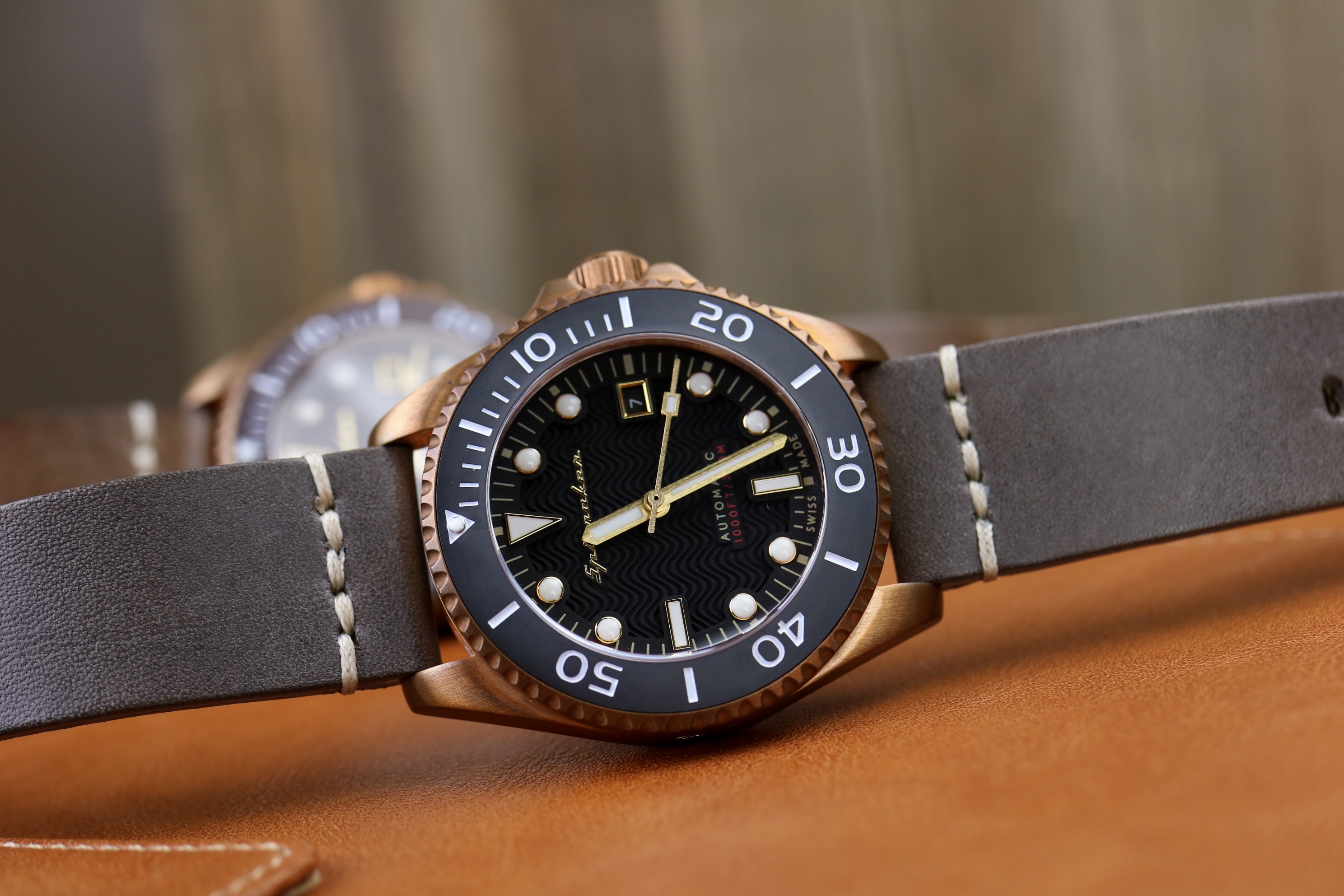
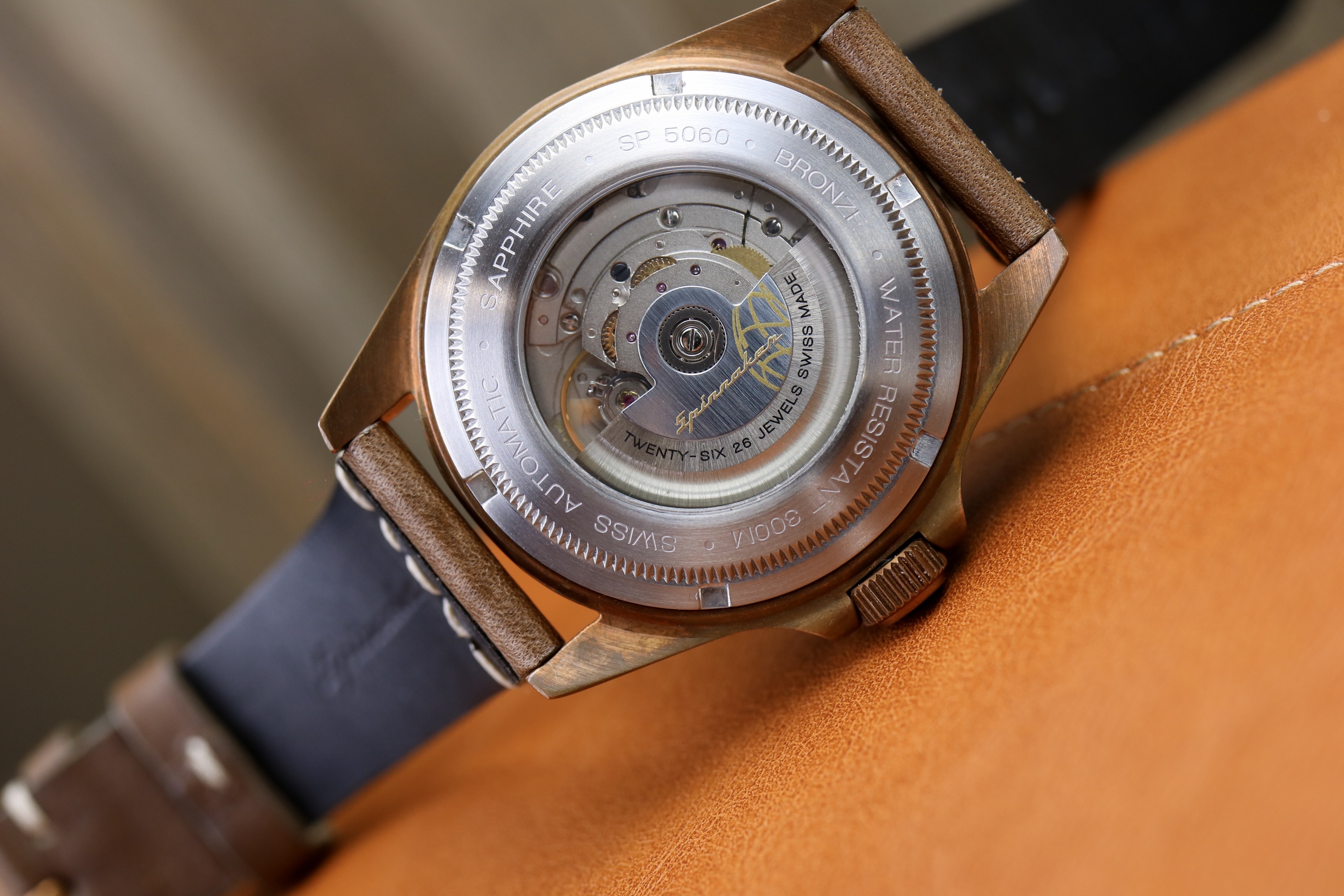
The Spinnaker Tesei is the latest from the Hong Kong Headquartered brand and it has some great improvements over past Spinnaker Watches. All versions are CuSn8 Bronze and have sapphire crystals, matte ceramic bezels and an SW200 movement from Sellita. Because of time constraints, this will not be a full article, but please watch the 12-minute video above and you can see my hi-res photos below as well.

If you want to get the best price possible, the Tesei is currently still up for pre-order until November 5, 2018, for $599. To save even more, use code Watchreport20, which will knock another $20 off the price. That is of course if you are interested in the watch because as you may know, we are not here to sell you a watch.

Spinnaker Tesei

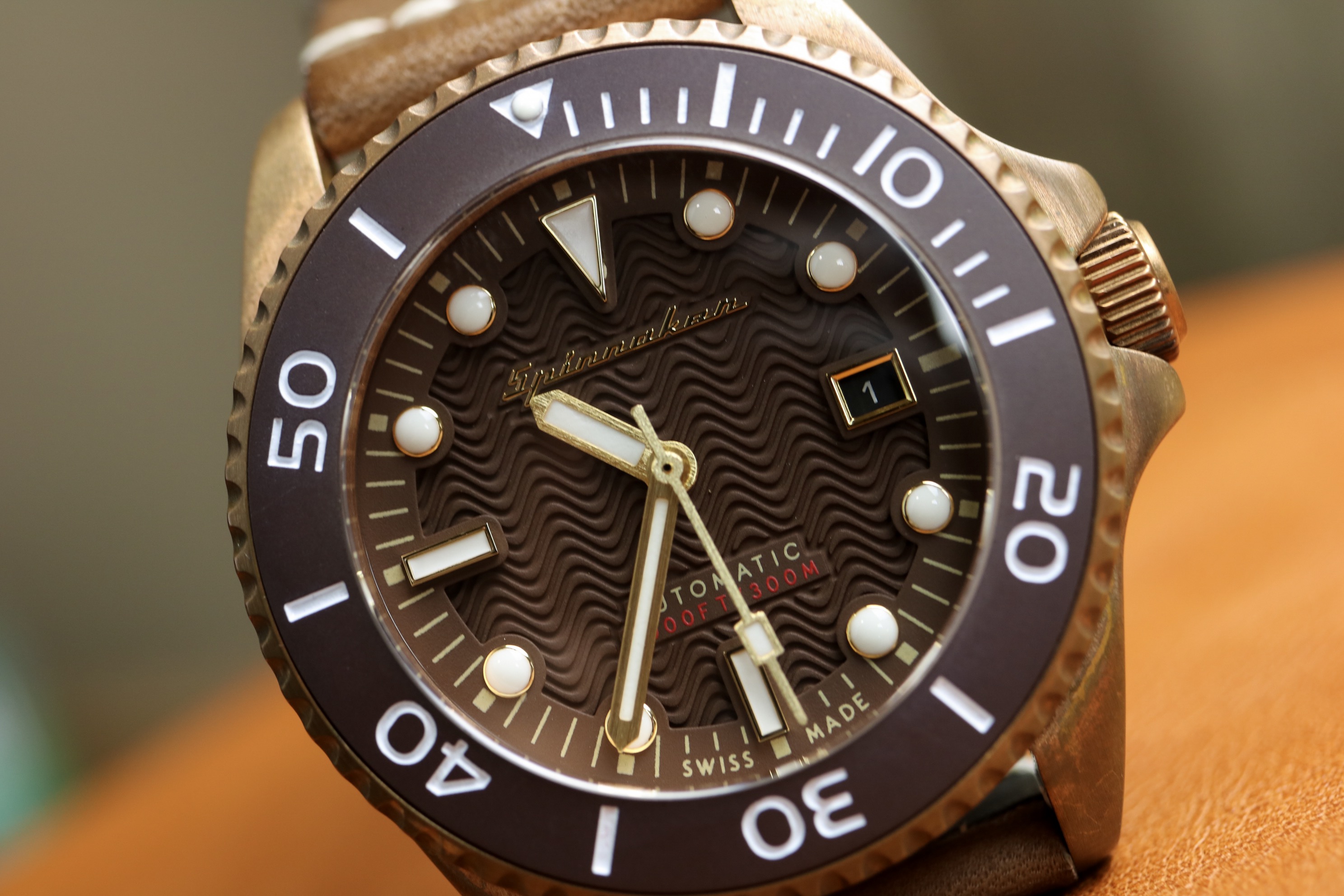
The Spinnaker Tesei comes in 4 different colors, which you can see at their website HERE. Coming in at 43mm, it is a nice size and the quality and overall finish are on par with other watches at this price point, the issue is, after the preorder period, this watch will retail for $850, and at that price, there is a lot of brands competing for your money. I think this is a great direction for the Spinnaker brand and can honestly say, the watch is very nicely made and has a great look to it, even if derivative of others. The embossed wave dial is a nice aesthetic and I don’t feel it makes it gimmicky or too in your face. Text on the dial has been kept to a minimum as well and while the hands will not patina like they case will, they are made from bronze as well.

Spinnaker Tesei

My personal favorite of all of them has to be the chocolate brown version above, as the warm tones really compliment the bronze case and should only look better as it continues to patina. How far it will patina is up to you and like all bronze watches, if it gets a little too dark for your liking, you can always polish it up to look like new again. Search online and you will find a few methods to do this, which one you do is up to you.

Spinnaker Tesei

Above you can see the SW200 movement through the exposed case back and overall, the Spinnaker Tesei is a nice leap for the brand. At $599, or less if you use our code, it is a nice deal in my opinion. At $850, it might be stretching a little bit, at least with the heavy competition out there. As usual, it comes down to is it worth it to you, which only you can decide. After you watch the video review, please take a second to subscribe to our Youtube channel if you are not already, and hit the bell to receive all notifications. If you have any questions or comments, please leave them below the gallery.


from Best Watches For Men https://ift.tt/2CUUxpn

Thursday, November 1, 2018

A Conversation Between A Watchmaking Student And His Instructor

Henrik Korpela is the director and instructor of KHWCC (K&H Watchmaking Competence Centre) and sat down with CJ who is currently enrolled in his second and last year to hear about his future plans after graduation as well as how he found the KHWCC and what he is currently practising among other questions. As well as CJ asking Henrik (HK) questions he thinks are interesting for the readers.

K&H Watchmaking Competence Centre

HK: What made you decide to come to study watchmaking in Switzerland?

CJ: After reading the school blog and talking to the alumni who are already in the program at that time. I know the school spends a year focusing on the very fundamental part of watchmaking, micro-mechanics, that I have always liked to do but haven’t had a chance before. Knowing the school provides a complete curriculum to build up watchmaker’s knowledge and techniques re-enforced my decision to join this school.

Before coming to Switzerland, I had an apprenticeship in a small workshop in Taiwan for 8 months, after that I moved to the U.S. with my wife for her study at business school. During that time I set up my own little workshop and do watch service for friends as a hobby. I enjoyed troubleshooting when working with movements, but I wasn’t satisfied by just replacing parts. Also, I want to learn more knowledge behind the movement and manipulating techniques when working on it, especially the escapement, balance and hairspring, the most delicate part which I was always afraid to deal with them.

HK: What parts of watchmaking fascinates and excites you the most?

CJ: Micro-mechanics, such as lathe turning, jig boring and finishing. It is always fun and satisfied making tools or finishing parts.

HK: If you could choose to do anything in the watchmaking world, from your experience and knowledge so far, what would you choose to do? What is your dream?

Le Locle is a very good environment for 2 years concentration of learning “Watchmaking Kung Fu” – CJ

CJ: I would love to do some watch restoration because it’s full of challenge and every watch is different. Not just to figure out the proper approaches for restoration, but also try to keep the movement as original as it was. Meanwhile, you also have to know the history of the watch, like what techniques and materials were used during that time and then you decide how to overcome the challenge.

Finishing, I also like doing finishing very much. I really enjoy the process of filing, polishing bevels, and surface treatment like frosting.

HK: How is it to live here in LeLocle? I can imagine it must be very different from where you come from. Any advantages or disadvantages?

CJ: Le Locle is a very good environment for 2 years concentration of learning “Watchmaking Kung Fu”, because of its location hence not many distractions here. Living cost is relatively low compared to other cities in Switzerland.

For the weather, it’s very comfortable for me. I am from Taiwan, in my country during summer it’s hot and humid, and winter cold and humid. Here in Le Locle, it’s pretty dry and chill (because of its altitude).

If I want to say something disadvantageous, it could be the travel distance. To me, it feels like at least two hours to any other place by train. But the train in Switzerland is very comfortable and always on schedule, so it’s actually not a big problem for me.

HK: What has so far been the most challenging part for you to learn?

CJ: I would say, finishing. Especially internal round bevel, I still need a lot of practice. Turning pivots and hairspring is also quite challenging in the beginning (both are very delicate), but we have a lot of practice during the course, so it’s actually not really scary after practising. We just have to get used to it.

HK: What are your plans after graduating?

CJ: Ideally, I would like to find a position in after-sale service and accumulate as many experiences as possible. The best is to be able to work with vintage and modern movements at the same time.

CJ interviewing Henrik

Let’s switch roles for a minute, CJ will ask some questions to Henrik about watchmaking and the KHWCC.

CJ: After graduation where do your alumni find jobs?

HK: Some of them are working in Canada, two of them are already independent with their own brand, one is working in NYC for a famous high-end brand, two are working in London (one for a large group and the other for an independent), one student is independent in China mainland, another one in Hong Kong. I have students in England, Mexico and Germany who work for independent service centres. So it’s very mixed where they end up working, either for independents, or they become independent themselves but also for large groups and famous brands. I also had students working for the celebrated independent watchmaker Roger Smith in the Isle of Man.

CJ: What is the educational approach at KHWCC?

HK: I value individual style teaching with small classes, but we also have group discussions and group exercises so that the students also learn to collaborate and work in group settings. The students also have lots of tools and equipment at their disposal, this greatly enhances the creative part of the course as they have less downtime. As I am a watchmaker myself I try to approach the students from time to time as a professional in order to make the experience as much as possible close to how they would work when they get a job as watchmakers, towards the end of their course I approach them more and more as if they are already professional watchmakers.

As I am running my own private school it allows me great flexibility and freedom as a teacher, which I know I could never get working in an industrial school or government school, of course this also allows me much greater freedom dealing on a very individual basis with my students while at the same time keeping up with the industry standards and emphasizing on strong fundamentals such as micromechanics.

I know for sure it is a good educational approach as so far all of my graduate students after the course have gotten watchmaking jobs and remain part of this amazing discipline/art/craft without failure so far.

CJ: Why did you choose Le Locle as the location for the school?

HK: It was for very obvious reasons I choose le Locle, it’s really the centre of watchmaking and I have everything I need close by.

CJ: What is your expectation of future students?

HK: I hope they will find watchmaking interesting and that they are curious about this wonderful profession and art.

“Life is about living not observing it pass by.” – Henrik

CJ: Do you have any suggestion for them?

HK: If you passionately really want something in life, don’t give up even after failing multiple times, the best way to grow is by failing and do get used to failure if you want to be strong or have something interesting and fulfilling in your life. Although it is practical to be flexible to changes in this ever faster evolving world we live in. Anything you get easy will have no value to you tomorrow. Life is about living not observing it pass by.

CJ: What kind of character are you looking for in watchmaking students?

HK: I am not sure I look for any specific character. I think it’s better to look at how a person reacts to this type of work, if the student does not naturally reject this type of work but more naturally gravitates towards it with curiosity I think that would be a good sign even independent of the person’s character. My belief is that skills can always be trained no matter what the character is. Would it not be great to have many different types of characters in this industry?

K&H Watchmaking Competence Centre (KHWCC) in Le Locle, Switzerland, offers comprehensive classical watchmaking training. A well-equipped independent academy that offers intimate class sizes. The program of the two years full skill course covers both modern and classical watchmaking techniques, encompassing all the skills needed for watchmaking, repair and restoration. The school currently has a class of four pupils, with the new academic year starting in April 2019. Additional information on the school and its various courses can be found on their homepage:  www.khwcc.ch .

*This article was written by Joseph Bentley


from Best Watches For Men https://ift.tt/2RsRtoe

In Partnership – The Art Of Complexity, Episode 1: A History Of Complications At Audemars Piguet

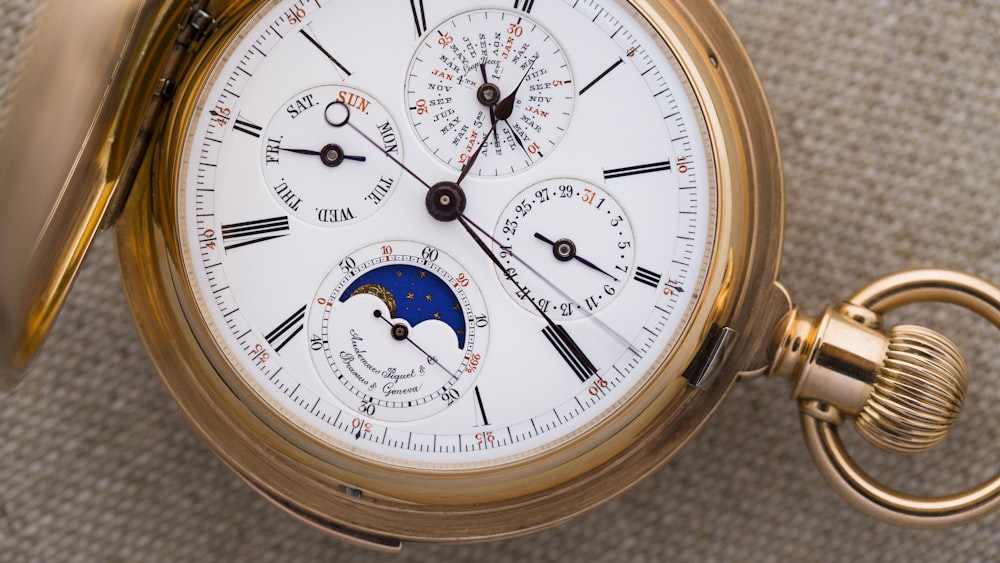
The extreme difficulty of making highly complex timepieces – including perpetual calendars, and perhaps the most challenging of all, chiming watches – made Audemars Piguet, from the beginning, one of only a tiny handful of companies capable of producing them, up to and including so-called “grand complication” timepieces, which combine chiming mechanisms such as the minute repeater and grande sonnerie with other complications. This degree and direction of specialization meant that production of watches at Audemars Piguet was very small relative to the industrially oriented watchmaking that dominated, and still dominates, much of the rest of the industry. Astonishingly, Audemars Piguet did not begin using the reference number system for serially produced watches until 1951; prior to that, every AP timepieces was essentially a unique piece and even afterwards, in many cases, series production meant the creation of just a handful of very labor-intensive timepieces, with meticulously crafted dials and cases as beautifully made as the mechanisms they housed.


from Best Watches For Men https://ift.tt/2JArTeE